

Conditional job offers in NZ: when an employer can withdraw and what claims apply
When a conditional offer of employment is made to an employee and that offer is accepted and the employer later moves to withdraw that offer unfairly, the employee can make a claim for unfair dismissal, regardless of whether that employee has started work.
Conditional offers of employment - withdrawing the offer can still be dismissal
When a conditional offer of employment is made and accepted, the employer cannot always simply withdraw it. Depending on the facts, the employee may be a "person intending to work" and have the right to bring a Personal Grievance (PG).
Key points
- An offer of employment once accepted and then withdrawn can amount to dismissal, even if the employee has not started work.
- Once accepted, fair consultation and fair dealing is required if the employer is attempting to revoke the offer.
- If an employment relationship has been created by offer and acceptance, the employer must be able to justify ending it.
A person intending to work
The Employment Relations Act defines a person intending to work as a person who has been offered, and accepted, work as an employee. Under ordinary principles of contract law, an offer once accepted cannot be withdrawn.
- An employee can include a person who has not yet started work but has been offered work and has accepted that offer.
- An offer of employment is capable of being accepted regardless of further details to be finalised.
Offer letter for employee
Often an employer will require certain conditions to be met before a prospective employee starts work. If by conduct an employment relationship is created by offer and acceptance, regardless of any conditions (reference checks, background checks, credit checks, drug testing, etc), the employee has rights under the Employment Relations Act 2000.
An offer of employment once accepted and then withdrawn by an employer will amount to dismissal, even if the employee had not started work on what would have otherwise been their first day on the job.
Once accepted, fair consultation and fair dealing is required of an employer attempting to revoke a conditional offer of employment.
If an employment relationship has been created by offer and acceptance before an onboarding process is completed, and the employer decides not to go ahead with continuing to employ that employee, the employer must be able to justify their decision.
A person intending to work
The Employment Relations Act defines a person intending to work as a person who has been offered, and accepted, work as an employee.
- An employee can include a person who has not yet started work but has been offered work and has accepted that offer of employment.
- Under ordinary principles of contract law, an offer once accepted cannot be withdrawn.
- An offer of employment is capable of being accepted regardless of further details to be finalised.
Regardless of any conditions to an offer of employment, if a person has accepted an offer of employment, that person will become a person intending to work under the Act and they will acquire statutory rights including being able to pursue an unfair dismissal personal grievance claim if the employer later tries to withdraw the offer.
If an employer cannot justify dismissal, the employee will become entitled to compensation and reimbursement of lost wages.
Read our full article
We write for the Deals on Wheels magazine. Read our full article here: Conditional offers of employment and unfair dismissal
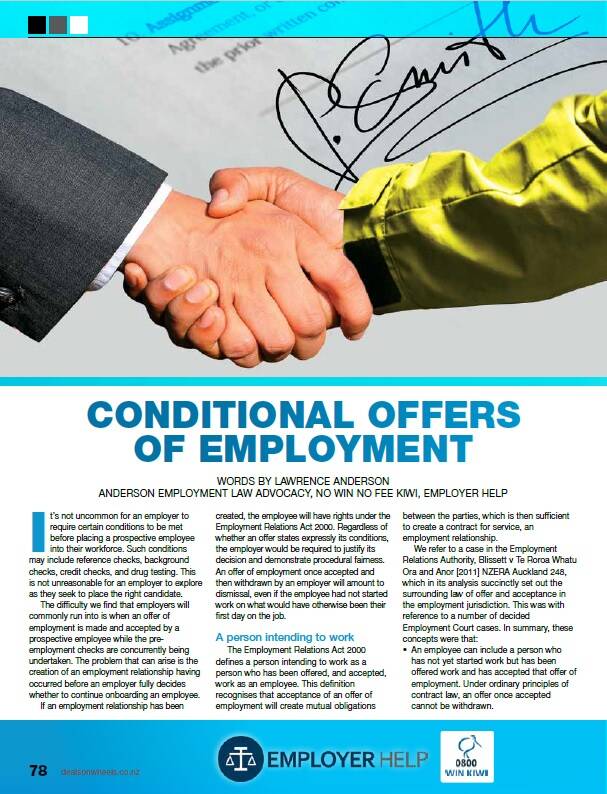 Download File: Conditional offer of employment
The fastest way is to submit the case form with a short timeline and key documents.
Employee Unfair Dismissal Case Form
Related articles
Browse all articles
Medical incapacity dismissal: fair process and reasonable timeframes
Employers are not expected to keep a sick or incapacitated employee's job open for an indefinite period. The tests of fairness and reasonableness apply.

Evidence for unjustified dismissal personal grievance claims: what to collect
Unfair Dismissal and Personal Grievance cases require the employee to give evidence and provide clear and convincing proof to support their claim. Employee advice on evidence gathering.
Unjustified redundancy: when redundancy becomes an unfair dismissal personal grievance
The Employment Court upheld a determination of the Employment Relations Authority that an employer pay its former employee substantial compensation for hurt and humiliation in remedy of the redundancy having been found unjustifiable.
Who is the employer? identifying the true employer in NZ employment claims
Where there is confusion or ambiguity of the identity of the employer the legal test requires an objective observation of the employment relationship at its outset with knowledge of all relevant communications between employer and employee.

Recording workplace conversation in NZ: what is legal and what backfires
You do not need permission to record a conversation that you are party to but there are consequences that you may face later if you record conversations without permission.

Disciplinary meetings: employee rights and common employer mistakes
In a disciplinary meeting an employee has rights to procedural fairness and to be fairly heard. We represent employees at disciplinary meetings.