
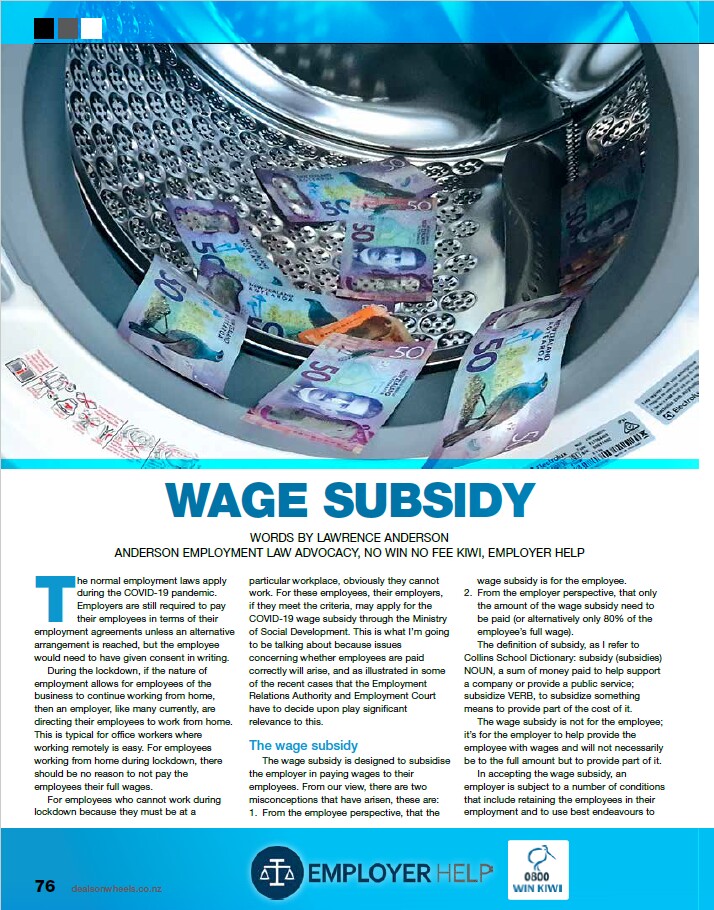
Covid-19 wage subsidy: employer obligations and wage protection risk
The New Zealand Covid-19 Wage Subsidy is designed to subsidise the employer in paying wages to their employees. Breaches of the Wages Protection Act.
Wage subsidy support created employment law risk as well as financial relief. The legal issues are usually not about the subsidy itself - they are about what the employer did next: pay cuts, reduced hours, leave, or restructuring decisions.
Key points
- Wage subsidy payments did not automatically give an employer the right to change pay or hours.
- Any change to wages, hours, or duties usually requires a proper process and agreement (and must still meet minimum standards).
- Records matter: if it ends up in the Employment Relations Authority (ERA), documentation and payroll accuracy become critical.
Wage Subsidy Covid-19
The normal employment laws apply during the Covid-19 pandemic. Employers are still required to pay their employees in terms of their employment agreements unless an alternative arrangement is reached, but the employee would need to have given consent in writing.
The wage subsidy is not for the employee, it is for the employer to help provide the employee with wages, and will not necessarily be to the full amount, but to provide part of it.
In accepting the wage subsidy an employer is subject to a number of conditions which include retaining the employees in their employment and to use best endeavours to pay at least 80 percent of their employees wages. The 80 percent stipulation were part of the conditions of the contract between an employer and the Ministry of Social Development when the employer applies for and receives the subsidy.
Wage Subsidy employee claims
If an employer does not pay their employees appropriately while receiving the wage subsidy, employers could face consequences:
- Not paying full wages can amout to an unlawful deduction if a worker has not consented to the deduction in writing in terms of the Wages Protection Act 1983.
- If an employee is not paid any wages while the employer receives the wage subsidy, the employee can bring a personal grievance for unjustified disadvantage and claim their wages in this way.
- Whether the Minimum Wage applies to employees being paid for not working in terms of the Wage Subsidy is still to be decided by the Court of Appeal.
Wage Subsidy advice for employers
We are now into our second year of Covid-19 and lockdowns. We appreciate that every situation is different and we endorse that employers should get specific advice for the situation that they face.
- If an employer wishes to pay less than full wages during lockdown, try and entice your employees to consent in writing to reduced wages.
- For new employees, employers would be smart to include a specific deduction clause regarding Covid-19 lockdowns and the wage subsidy to obtain written consent from the outset of employment with new employees.
- Until the Court of Appeal resolves the recent challenge to Gate Gourmet New Zealand Ltd v Sandhu [2020] NZEmpC 237, pay at least the minimum wage when passing on the wage subsidy. But be aware of the other issues that arise as discussed here.
- Employers paying out holiday pay to top up employee pay is an option. Be careful that you are doing so under the rules prescribed by the Holidays Act 2003.
Covid-19 Update
Sandhu v Gate Gourmet New Zealand Ltd [2021] NZCA 591, judgment 11 November 2021
Now a recent win regarding minimum wage issues. In an article I wrote for the magazine for September 2021 where we also looked at a recent Employment Court decision that found that workers were not entitled to the minimum wage when off work during a level 4 lockdown, this was very recently overturned by the Court of Appeal. The Minimum Wage is still payable even if employee not needed for work.
Employees who are willing and able to work but are told by their employer that they are not needed for work must still be paid at least the minimum wage for the hours already agreed to be performed.
Since lockdowns began we have seen many employers unilaterally decide to pay their employees 80 percent of their normal wages, or in some cases just the wage subsidy. While personal grievances could be relevant claims, if the amount paid falls below the minimum wage whilst not performing work, employees effected can now claim their entitlement to be paid at least the minimum wage for unpaid time during lockdown despite having agreed to be paid less than the minimum wage. Parties cannot contract out of law with respect to minimum employment entitlements.
Read our full article
We write for the Deals on Wheels magazine. Read our full article:
 Download File: Wage Subsidy Covid-19
If you need advice on pay reductions, subsidy-related disputes, unpaid wages, or dismissal risk, contact us.
Employee Unfair Dismissal Case Form
Employment law advice for employers
Related articles
Browse all articles
ERA settlements and s 150A "Payment on resolution of problem": paying advocates directly and GST Invoices
Parties can agree that an advocate is paid directly by the employer in terms of an s 149 record of settlement. "Payment" excludes legal or advocacy services where such service is a separate term of the settlement and a GST invoice for a defined sum is provided to the other party.
Federated farmers employment agreement disputes: common issues for NZ farmers
The Federated Farmers Employment Contract is commonly used by farmer employers. We represent employers in employment disputes where problems arise with these contracts. The correct preparation and execution of the Federated Farmers Employment Agreement is important for the farmer employers that use them.

"No win, no fee" for employers: when it exists and what to do instead
There are a lot of employers who think that "No Win, No Fee" is an arrangement available to their business in defending a personal grievance or other claims.
Employment lawyer fees: avoiding unreasonable costs when defending a personal grievance
Employers beware of high employment lawyer fees when defending a personal grievance claim. Even if you win, recovering your actual legal spend in the ERA is usually limited by the daily tariff approach.
Who is the employer? identifying the true employer in NZ employment claims
Where there is confusion or ambiguity of the identity of the employer the legal test requires an objective observation of the employment relationship at its outset with knowledge of all relevant communications between employer and employee.
Unpaid wages: penalties, arrears, and employer liability
The Employment Relations Authority is able to award penalties against an employer where the employer has sustainably failed to pay wages and minimum entitlements.