

Constructive dismissal: when resignation becomes an unfair dismissal personal grievance
Constructive dismissal (resignation) personal grievance law. If your employer is pushing you to resign, get advice first. In many cases, do not resign.
Do not resign until you get advice
Constructive dismissal is the "wolf of dismissal in the sheep's clothing of resignation". If you resign, you may lose leverage and you can make the case harder than it needs to be.
A constructive dismissal is where an employer places an employee in a position where the employee has no choice but to resign. Where an employee resigns and claims constructive dismissal, the onus is on the employee to show that a dismissal has occurred. In essence, constructive dismissal is where the employee has fired the boss.
"It is the Wolf of dismissal in the sheep's clothing of resignation"
New Zealand Woollen Workers IUOW v Distinctive Knitwear NZ Ltd
The Court of Appeal has said constructive dismissal includes cases where:
Auckland, etc, Shop Employees, etc, IUOW v Woolworths (NZ) Ltd
- An employer gives an employee an option of resigning or being dismissed.
- An employer follows a course of conduct with the deliberate and dominant purpose of coercing an employee to resign.
- A breach of duty by an employer leads an employee to resign.
The courts have developed further case law around constructive dismissal, including:
- The "but for" test. If it was not but for the breach of duty of the employer.
- The "reasonably foreseeable" test. Was the breach of duty sufficiently serious that it was reasonably foreseeable there was a substantial risk of resignation?
- The "final straw" or the "cumulative effect".
Before you resign - practical steps
- Pause: do not send a resignation message in the heat of the moment.
- Get advice: talk to an advocate or lawyer before you resign.
- Document events: keep texts, emails, meeting notes, rosters, and anything showing unfair treatment.
- Raise concerns carefully: in many cases, it is better to raise issues in writing before resignation.
- Avoid "venting": keep communications factual and professional.
While we often advise employees not to resign and instead allow the employer to make the dismissal decision (so we can run an actual unjustified dismissal case), there are situations where a resignation and constructive dismissal claim can be the better option. Proper and timely advice is recommended before taking action.
If you are contemplating resignation because of unsatisfactory treatment, or a situation has led you to lose trust and confidence in your employer, talk to us first.
Do not resign until you speak to us.
The fastest way is to submit the case form with a short timeline and key documents.
Employee Unfair Dismissal Case Form
Dismissal and resignation
Whether it is a disciplinary meeting, a workplace investigation, or a performance issue, a common scenario is the employer proposing termination and then offering a resignation instead.
Our general advice is: do not resign until you have advice.
If you resign, you can weaken your ability to raise a Personal Grievance for unjustified dismissal.
Involve us early and you will usually be in a much better position to achieve a strong outcome.
Settlements and compensation
Where an employer is going to dismiss an employee but offers that the employee can resign, the employee can often take this approach with our help:
- Do not resign.
- If the dismissal is unjustified, we will raise a Personal Grievance for unjustified dismissal.
- We will negotiate with the employer to achieve a settlement before, at, or after employment mediation.
- The settlement can record that the employee resigned, rather than being fired.
- We often negotiate a reference or certificate of service.
If settlement is not achieved because of the employer's refusal to negotiate, we then take the case further to the Employment Relations Authority (the ERA).
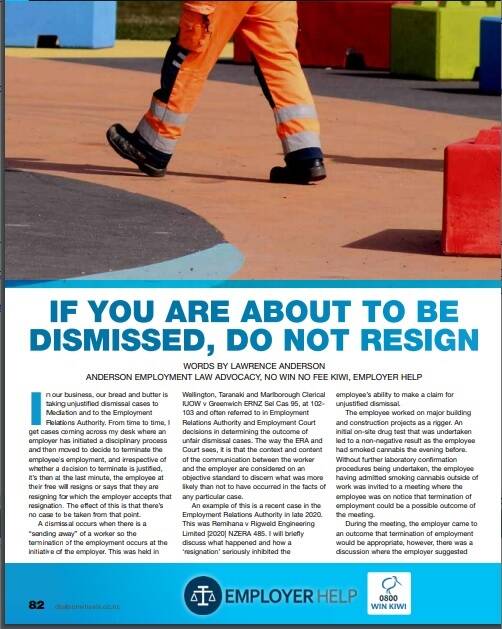
Read our full article
We write for the Deals on Wheels magazine. Read our full article here: If you are about to be dismissed, don't resign
Related articles
Browse all articles
Medical incapacity dismissal: fair process and reasonable timeframes
Employers are not expected to keep a sick or incapacitated employee's job open for an indefinite period. The tests of fairness and reasonableness apply.

Evidence for unjustified dismissal personal grievance claims: what to collect
Unfair Dismissal and Personal Grievance cases require the employee to give evidence and provide clear and convincing proof to support their claim. Employee advice on evidence gathering.
Unjustified redundancy: when redundancy becomes an unfair dismissal personal grievance
The Employment Court upheld a determination of the Employment Relations Authority that an employer pay its former employee substantial compensation for hurt and humiliation in remedy of the redundancy having been found unjustifiable.
Who is the employer? identifying the true employer in NZ employment claims
Where there is confusion or ambiguity of the identity of the employer the legal test requires an objective observation of the employment relationship at its outset with knowledge of all relevant communications between employer and employee.

Recording workplace conversation in NZ: what is legal and what backfires
You do not need permission to record a conversation that you are party to but there are consequences that you may face later if you record conversations without permission.

Disciplinary meetings: employee rights and common employer mistakes
In a disciplinary meeting an employee has rights to procedural fairness and to be fairly heard. We represent employees at disciplinary meetings.