
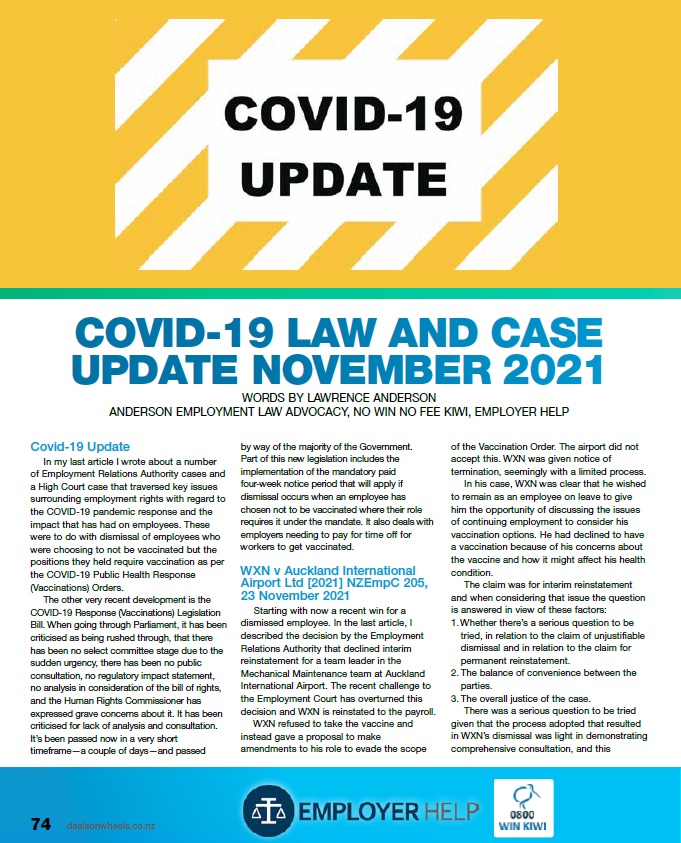
Covid-19 Response (Vaccinations) Legislation Act 2021: vaccination and employment law
A paid four week notice period will apply if dismissal occurs when an employee has chosen not to be Covid-19 vaccinated. Covid 19 Response (Vaccinations) Legislation Act 2021 advice. It also deals with employers needing to pay for time off for workers to get vaccinated.
The Covid-19 vaccination legal framework created practical questions for employers and employees: notice, paid time to vaccinate, workplace policies, and how to manage disputes without turning them into unjustified dismissal claims.
What this page covers
- The 4-week notice concept and why written process matters.
- Paid time for vaccination and what "reasonable time" looks like.
- Common failure points: rushed decisions, poor consultation, and weak documentation.
COVID-19 Response (Vaccinations) Legislation Act 2021
The COVID-19 Response (Vaccinations) Legislation Bill. When going through Parliament, it has been criticised as being rushed through, that there has been no select committee stage due to the sudden urgency, there has been no public consultation, no regulatory impact statement, no analysis in consideration of the bill of rights, and the Human Rights Commissioner has expressed grave concerns about it. It has been criticised for lack of analysis and consultation. It's been passed now in a very short timeframe, a couple of days, and passed by way of the majority of the government.
Part of this new legislation includes the implementing of the mandatory paid four week notice period that will apply if dismissal occurs when an employee has chosen not to be vaccinated where their role requires it under the mandate. It also deals with employers needing to pay for time off for workers to get vaccinated.
We have only had a few days to digest this COVID-19 Response (Vaccinations) Legislation Bill which has been passed through under urgency. This makes amendments to the COVID-19 Public Health Response Act 2020 and to the Employment Relations Act 2000. These amendments have been enacted for the new COVID-19 Protection Framework and this new "traffic light system".
The legislation, via further Orders, will require the roles of those working in situations where use of a vaccine certificate is required, or can be used, to be filled by vaccinated workers. Where a vaccine certificate is required for customers covered by the My Vaccine Pass mandate, for example, workers in hospitality, events, gatherings, close contact businesses and gyms, these workers will need to have their first vaccination injection by 3 December 2021 and they are required to be fully vaccinated by 17 January 2022. An employee can apply for exemption status and subject to criteria they may or may not be granted an exemption which if granted would only have effect for no more than six months at a time.
Section 238A is being inserted into the Employment Relations Act 2000, Provisions relating to COVID-19 vaccinations, and this cross references Schedule 3A which I go on to describe.
Firstly, all employees will be entitled to reasonable paid time off to be vaccinated, including to receive the vaccination booster shots. But this is subject to whether providing the time off would unreasonably disrupt the employer's business or the performance of an employee's duties.
Where termination of employment is going to arise following that the employee cannot carry out work under the health order, the employee will be entitled to the greater of four weeks' paid notice of termination or if their notice period as prescribed by their employment agreement is greater than four weeks, that greater period of notice will apply.
This provision also provides where an employer has determined that the employee must be vaccinated, in which case the employer must give the employee reasonable written notice specifying the date by which the employee must be vaccinated in order to carry out work. It has been announced that there will be a Vaccination Assessment Tool released in mid December to help employers decide whether a worker would require vaccination. It will specify four key factors and at least three of them must be met before it would be reasonable to require vaccination for particular work. This will cover the size of the space in which the role is performed, the proximity to other people, the length of time in which the person performing the role is in proximity to others, and whether the work involves providing services to people who are particularly vulnerable to COVID-19. If an employer determines an employee occupying their position must be vaccinated, this reasonable notice procedure must apply in order to give the employee an opportunity to become vaccinated before the employer can then give written notice of termination.
If termination is going to proceed, the employer must also first ensure that all other reasonable alternatives that would not lead to termination be exhausted.
If within the notice period that is not less than four weeks, should the employee become vaccinated or otherwise permitted to perform work, then the termination is cancelled and of no effect. But again, another grey area arises by this legislation that goes on to say that the cancelling the notice of termination does not apply if the cancelling the notice would unreasonably disrupt the employer's business.
Personal grievance rights to bring a grievance for unjustifiable dismissal will be unaffected by these changes.
Law on dismissal for not being vaccinated
The normal tests for unjustifiable dismissal still apply and nothing has changed in this regard. Neither will the Covid-19 response change how the law is applied to unjustifiable dismissal claims.
An employer has the usual obligation to justify its actions having regard to section 103A, Test of Justification, and section 4, the Good Faith provisions of the Employment Relations Act 2000. This will also include the Authority or Court making an objective assessment on a principled basis the question of whether the employer by its actions conducted itself in a way that a fair and reasonable employer could have done in all the circumstances at the time the dismissal or actions occurred.
Read our full article
We write for the Deals on Wheels magazine. Read our full article:
 Download File: Covid 19 Response (Vaccinations) Legislation Act 2021
Practical employer process (high level)
- Confirm the legal basis for your policy (role risk, site requirements, health and safety duties).
- Consult early. Give written information, real time to respond, and keep an open mind.
- Consider alternatives before termination (adjusted duties, redeployment, leave arrangements).
- Document the decision and reasons clearly.
If your workplace is facing vaccination-policy disputes, suspension, or dismissal risk, contact us.
Employee Unfair Dismissal Case Form
Employment law advice for employers
Related articles
Browse all articles
Medical incapacity dismissal: fair process and reasonable timeframes
Employers are not expected to keep a sick or incapacitated employee's job open for an indefinite period. The tests of fairness and reasonableness apply.

Evidence for unjustified dismissal personal grievance claims: what to collect
Unfair Dismissal and Personal Grievance cases require the employee to give evidence and provide clear and convincing proof to support their claim. Employee advice on evidence gathering.

Unjustified redundancy: when redundancy becomes an unfair dismissal personal grievance
The Employment Court upheld a determination of the Employment Relations Authority that an employer pay its former employee substantial compensation for hurt and humiliation in remedy of the redundancy having been found unjustifiable.
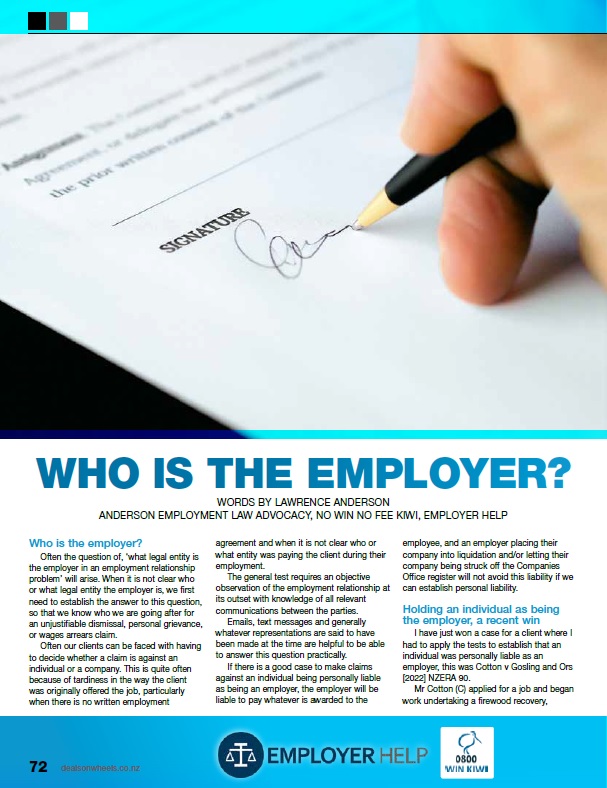
Who is the employer? identifying the true employer in NZ employment claims
Where there is confusion or ambiguity of the identity of the employer the legal test requires an objective observation of the employment relationship at its outset with knowledge of all relevant communications between employer and employee.

Recording workplace conversation in NZ: what is legal and what backfires
You do not need permission to record a conversation that you are party to but there are consequences that you may face later if you record conversations without permission.

Disciplinary meetings: employee rights and common employer mistakes
In a disciplinary meeting an employee has rights to procedural fairness and to be fairly heard. We represent employees at disciplinary meetings.