

Employee ERA costs uplift: when the Authority increases costs awards
When an employee is successful in the Employment Relations Authority (ERA), the employee can seek a contribution to costs. Costs can be uplifted above the daily tariff where employer conduct increases time and expense.
Costs awards for employees in the ERA
A successful employee in the Employment Relations Authority (ERA) can seek a contribution to costs. It is important to understand that costs in the ERA are usually a contribution (not full reimbursement), and the starting point is the Authority's daily tariff approach.
How costs are usually calculated
- Daily tariff: costs are often assessed against a notional daily rate (first day and subsequent days).
- Adjustments: the Authority may uplift or reduce the tariff amount based on conduct and fairness.
- Not punishment: costs are not meant to punish, but conduct that increases time and expense can be taken into account.
- Offers matter: Calderbank (without prejudice) offers can influence costs if they were reasonable and rejected.
Practical takeaways for employees
- Follow timetables: file what you are required to file, on time.
- Focus on the core issues: avoid unnecessary side disputes that inflate time and risk costs consequences.
- Keep evidence organized: a clear, credible case often resolves earlier and reduces cost risk.
- Be reasonable in settlement: unreasonable positions can backfire on costs even if you win some issues.
Example: costs uplift after employer conduct increased time and expense
As an example we refer to WATERS v S.T.L LINEHAUL LIMITED [2021] NZERA 350. STL Linehaul Limited was ordered to pay $17,000 compensation. The costs award that followed came to the amount of $9,071.56. Costs were uplifted from the daily tariff. The points raised in that decision included:
- STL was unsuccessful in applying to have the employee representative removed from representing Mr Waters.
- STL attempted on an informal basis to remove the substantive matter to the Employment Court. This was unsuccessful.
- STL failed to file witness statements as per timetable directions.
- Further difficulties arose in getting a signatory to the dismissal decision to give evidence. That did not eventuate.
- Other witnesses of STL gave evidence that was inconsistent with the witness statements that had been filed. This increased the duration of the hearing.
Dealing with these kinds of issues in an ERA matter will often result in costs being increased and uplifted. Where an employer pursues additional steps that do not succeed (for example, an application to remove a representative), that can be taken into account on costs after the substantive decision.
What this case shows
- Timetable failures and avoidable hearing delay can lead to higher costs.
- Unsuccessful interlocutory applications can increase costs exposure.
- The ERA will still take a principled approach and work from the daily tariff as the baseline.
Related articles
Browse all articles![Menzies v Corrigan [2025] NZEmpC 186 - employment advocate and employment lawyer conduct](/Images/EmploymentAdvocatesAuckland.jpg)
Menzies v Corrigan [2025] NZEmpC 186 - employment advocate and employment lawyer conduct
Mr Menzies lost company limited liability protection over grievance remedies in the ERA. We appealed to the Employment Court, but discontinued when it became futile. Catherine Stewart Barrister team repeatedly made veiled threats to seek a jail sentence against Mr Menzies in event of non-payment. Fresh evidence has led to a judicial review now underway.
Joyce v Ultimate Siteworks Limited [2024] NZEmpC 204 - representatives, employment advocate and employment lawyer conduct
Joyce v Ultimate Siteworks Limited [2024] NZEmpC 204 - Advocate and Lawyer Conduct. Breaching our client's privacy, using a complaint as a bargaining chip, pressuring us to discontinue representation and a SLAPP.
Employment lawyer fees: avoiding unreasonable costs when defending a personal grievance
Employers beware of high employment lawyer fees when defending a personal grievance claim. Even if you win, recovering your actual legal spend in the ERA is usually limited by the daily tariff approach.
Costs in the Employment Relations Authority: practice note, daily tariff, and uplifts explained
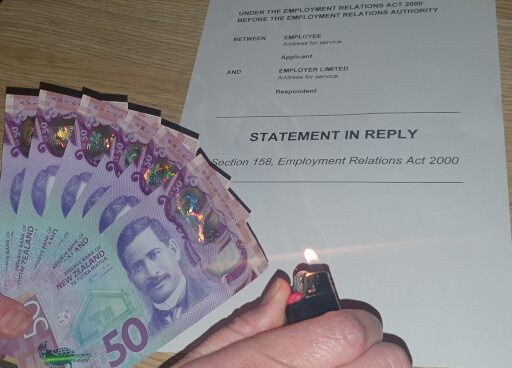
The Employment Relations Authority (ERA) issued an updated practice note on costs. The daily tariff remains $4,500 for the first day and $3,500 for subsequent days, with adjustments up or down based on the circumstances.
Employer ERA costs: when an employer can claim costs after winning
Employers are often shocked that even when they win in the Employment Relations Authority (ERA), recovering actual legal spend from an employee is usually limited. The starting point is the ERA daily tariff and costs are a contribution, not an indemnity.