
Workplace investigations and licensing (PSPLA): when investigators need a licence (NZ)
The New Zealand employment law scene still suffers with its unlicenced employment investigators. Many untrained workplace investigators who front themselves primarily as Human Resources consultants are holding themselves out as being investigator to the employer in employment investigations where they receive valuable consideration for doing so. A recent Private Security Personnel Licensing Authority (PSPLA) decision has confirmed the restriction on this practice where the investigator does not hold a licence.
Workplace investigations are often the turning point in employment disputes. If the investigation is flawed, the rest of the process is usually flawed too. This page explains the investigation role, typical failure points, and how to protect your position (employee or employer).
What usually goes wrong
- Predetermination, weak evidence testing, and selective use of information.
- Not giving the employee the core allegations and material to respond to.
- Rushed timeframes and no meaningful opportunity to be heard.
- Confusion about roles: investigator vs decision-maker.
Employment Investigators are required to have a licence
The Private Security Personnel Licensing Authority (PSPLA) is an Authority that was created under the Private Security Personnel and Private Investigators Act 2010. It's functions are that it issues licences and certificates of approval to people working in the security industry, and private investigators; holds a register of all licence holders; and has the ability to discipline if required.
A recent decision in the PSPLA has confirmed that those who are in business advertising and providing employment investigation services for valuable consideration need to either be a lawyer or hold a licence under the Act.
What about HR Consultants?
They can't get it from a Weet-Bix packet either
This now means that many Human Resource and employment experts (as they claim to be) are at risk of liability in breach of the Act. Simply, they should not be undertaking investigations without a licence, and many consultants are still doing so without proper training.
The end result is often damaging to the livelihood of employees where untrained or inexperienced Human Resource consultants continue to practice in undertaking employment investigations when they should not be.
The recent decision
D, E & C LIMITED [2020] NZPSLA 007.pdf
Dated 4 June 2020, the Authority made a decision addressing the issue of whether persons or companies carrying out workplace investigations for employers into employee conduct are carrying out private investigations and therefore they are required to hold a private investigator licence.
C Limited was contracted by A's previous employer. A had complained about the investigation particularly as to how it was conducted and that the directors of C Limited who carried out the investigation should have been licensed as private investigators under the Act.
The investigation that was the subject of the complaint was one where:
- Witnesses involved participate in an interview where they would have a support person or legal representative support them.
- The employer would provide the investigator relevant evidence for the purposes of the investigation and the investigator can seek further information.
- The complainant and respondent that are subject of the investigation are given the opportunity to review and to comment on the evidence that the investigator collects.
- A final investigation report is drafted for which the complainant and respondent are given the opportunity to review and comment on.
- The final investigation report is provided to the employer which sets out the investigators opinion on whether factual allegations occurred and if so whether that conduct amounts to a breach of the employer's relevant policies.
- In this Act, private investigator means a person who, for valuable consideration, either by himself or herself or in partnership with any other person, carries on a business seeking or obtaining for any person or supplying to any person any information described in subsection (2).
-
For the purposes of this section, information-
-
means any information relating to-
- the personal character, actions, or behaviour of any person; or
- the financial position of any person; or
- the occupation or business of any person; or
- the identity or whereabouts of any person; but
- does not include information that is contained in a public record.
-
means any information relating to-
- For the purposes of this section but without limiting the meaning of the term carries on any business, a person is carrying on a business if he or she holds himself or herself out to the public as being ready to carry on that business.
-
Despite subsection (1), no person is a private investigator within the meaning of this Act by reason of the fact that-
-
he or she seeks, obtains, or supplies any information-
- for or to the Crown, or any constable, or any local authority; or
- at the request of a person who is not a client of the business; or
- only as a necessary, usual, or reasonable incident of any other activity by that person that is not described in that subsection; or
- for any purpose relating to the dissemination of news or other information to the public or to any section of the public; or
- for any cultural or historical purpose or for any purpose relating to education, literature, or science; or
- relating only to the person by whom he or she is engaged or retained; or
- in the course of and for the purposes of the business of a bank, or of a credit bureau, or of a debt collecting agency; or
- he or she is a security technician, security consultant, confidential document destruction agent, repossession agent, property guard, personal guard, or crowd controller.
-
he or she seeks, obtains, or supplies any information-
As highlighted in bold in the Act as above, the key combination of ingredients are:
- Private Investigator
- Information
- Carries on any business
- (Additionally) Valuable consideration
The directors of C Limited did not have a licence at the time of the investigation in question but had since became registered lawyers. At the time of the investigation the directors of C Limited would have been in breach of the Act as they did not fall within any of the exemptions of the Act. Such circumstances, particularly that the breach was unintentional, did not warrant any penalty against the directors despite the breach at the time.
The Authority was satisfied that registered lawyers being accountable under the Lawyers and Conveyancers Act 2006 are able to undertake workplace investigations given their ethical obligations to that Act.
A disciplinary meeting can amount to an investigation as recognised by this Act
It is notable that despite the length and obvious nature of the process being an "investigation" is not what defines a private investigator, any process no matter how small where personal information is collected and decided upon by a person or company holding themselves out to do workplace investigations and receives valuable consideration for doing so will be accountable to this Act.
Simply, an external Human Resource consultant receiving payment for having involvement in a disciplinary meeting, although not framed "investigation", where they ask the complainant or respondent questions and report and discuss conclusions with the employer has effectively ticked all of the above boxes in satisfying this section of the Act. A simple disciplinary meeting can still be considered as being an investigation, it is not what you call the process, it is what the process is in satisfying this section of the Act.
The bottom line is that external Human Resource consultants or workplace investigators that do not hold a licence and are not practising lawyers are unable to carry out employment investigations and if doing so they will be in breach of the Act.
Importantly, employers can carry out investigations internally or use law firms and individual lawyers that have practising certificates. Of course licence holders under the Act are suitable for this area of work.
As an employer, What should you be asking?
- What are their qualifications?
- Are they a lawyer or do they hold a licence under the Act?
- How long will the process take?
- What is the process?
- What are the fees, disbursements and other costs involved?
- Can I see a copy of the Terms of Engagement before proceeding?
Employers should be careful who they are engaging to undertake their employment investigation because the investigator's actions can potentially put the employer at risk of their employee raising a personal grievance.
What should an employee subject to an employment investigation be asking?
- Who is the investigator?
- Are they a lawyer or do they hold a licence under the Act?
- What are their qualifications?
- How long will the process take?
- What is the process?
- What will happen to the information that they are collecting?
If you have any other questions or concerns or need help then don't hesitate to get in contact with us!
Related articles
Browse all articles
ERA settlements and s 150A "Payment on resolution of problem": paying advocates directly and GST Invoices
Parties can agree that an advocate is paid directly by the employer in terms of an s 149 record of settlement. "Payment" excludes legal or advocacy services where such service is a separate term of the settlement and a GST invoice for a defined sum is provided to the other party.
Federated farmers employment agreement disputes: common issues for NZ farmers
The Federated Farmers Employment Contract is commonly used by farmer employers. We represent employers in employment disputes where problems arise with these contracts. The correct preparation and execution of the Federated Farmers Employment Agreement is important for the farmer employers that use them.

"No win, no fee" for employers: when it exists and what to do instead
There are a lot of employers who think that "No Win, No Fee" is an arrangement available to their business in defending a personal grievance or other claims.
Employment lawyer fees: avoiding unreasonable costs when defending a personal grievance
Employers beware of high employment lawyer fees when defending a personal grievance claim. Even if you win, recovering your actual legal spend in the ERA is usually limited by the daily tariff approach.
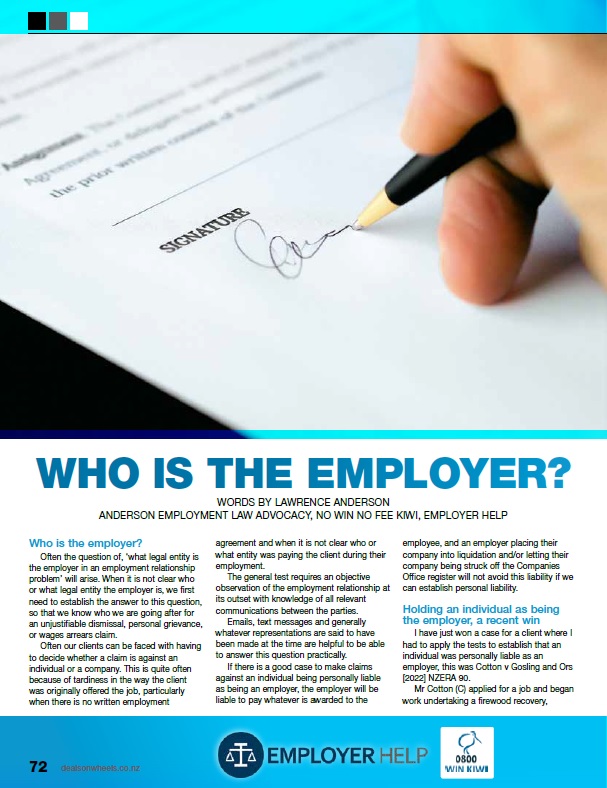
Who is the employer? identifying the true employer in NZ employment claims
Where there is confusion or ambiguity of the identity of the employer the legal test requires an objective observation of the employment relationship at its outset with knowledge of all relevant communications between employer and employee.
Unpaid wages: penalties, arrears, and employer liability
The Employment Relations Authority is able to award penalties against an employer where the employer has sustainably failed to pay wages and minimum entitlements.